Friday, April 29, 2011

Energy efficiency and Weight Watchers

By Elisa Wood
April 27, 2011

We’ve been hearing for years that the energy efficiency industry needs to find its equivalent to the cell phone. These days industry folks refer to it as the ‘killer app,” the revolutionary product or service that consumers can’t resist.

But lately, partly because I’m dieting, I’ve been thinking what energy efficiency really needs is something akin to a Weight Watchers dessert.

Let me explain myself.

Saving energy and saving calories share three precepts. They are most palatable to the consumer if they are devoid of self-sacrifice, appear invisible, and offer some element of delight. Weight Watchers has got these down cold. The energy efficiency industry is doing well with the first and second, but not the third.

No self-sacrifice

Weight Watchers is ingenious because it does not describe itself as a diet; it’s a lifestyle, a way of eating. It’s not about self-sacrifice. Sound familiar? The energy efficiency industry over the last decade shook off the ‘conservation’ moniker, much the way Weight Watcher abandoned the term ‘diet.’

The Alliance to Save Energy describes the difference between energy efficiency and conservation beautifully on its website:

But energy efficiency is a far cry from the energy conservation images and practices of old – of doing with less or doing without, of being uncomfortable or less comfortable. Not unlike the tremendous technological strides on the computer, electronics, and other fronts, energy efficiency takes advantage of advances in technology to provide significantly better, smarter services.

Invisible

On Weight Watchers you still can eat the macaroni and cheese. But it’s made with low fat milk. The calorie savings become invisible to me. Likewise, consumers can be energy efficient and still use their air conditioners and televisions as much as before. Appliance standards are the low fat milk of the energy industry. If you wonder about the significance of these standards read the efficiency section of the US Energy Information Administration’s recently released Annual Energy Outlook 2011. The report forecasts a 17% drop in residential per capita energy use through 2035 and says appliance standards often are “the primary reason for efficiency gains.” The currently controversial lighting standards create the biggest energy savings (See EIA chart below.)
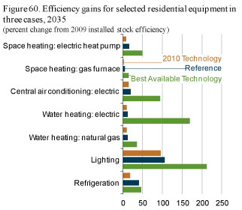
EIA graph

Delight

This one is easy for Weight Watchers. It offers wonderful little chocolate cakes that bring delight to the sweet tooth. But what is energy efficiency’s chocolate cake? Herein rests the problem for the industry. The cell phone, the IPod, the home computer – these technologies were readily adapted because of the delight and convenience they add to our lives. As far as I can tell, neither the smart meter nor any of the other energy savings technologies being offered for the home offer any of this kind of allure. Some folks in the energy industry say they never will because information technology and energy technology part ways here. They may be right. But I remain hopeful. Those who had the first home computers (mine was a DEC Rainbow 100) may remember that they offered far more in the way of frustration than fun or inconvenience. These early computers left critics of the industry doubtful that widespread penetration of home computers would ever occur….and we all know how that all ended.

Elisa Wood is the co-author of the recent white paper, “Exporting US Energy Efficiency.”

Wednesday, April 20, 2011

What's Denver doing on the EV-Ready list?

Guest Blog by Cara Miale
April 20, 2011

Looking at the list of the most EV-ready cities justreleased by Ford, it’s no surprise many of them are coastal. On the east and west coasts energy is pricey, so the pressure is on to achieve innovation that will control costs and reduce dependence on fossil fuels.

But what’s up with Denver out there in the middle of the map, all by its lonesome?

Government leaders in Colorado, and Denver specifically, have long been committed to sustainability and energy efficiency. Denver has worked hard over the years not only to position itself as a national leader in sustainability, but also to lead by example.

Denver was home to the first “Green Fleet” of city-use vehicles in the early 1990’s, which now includes 138 hybrid electric vehicles. The city hosted the greenest Democratic National Convention to date, and shows continued focus through clean-energy legislation. Its concentration of clean-energy workers and companies is on the rise, and Colorado continues to attract more venture capital financing for clean-tech start-ups than nearly any other state.

And, we’re not so alone after all. Denver is also participating in a U.S.-China “Eco Partnership” sponsored by U.S. Department of the Treasury, which is focused on the implementation of electric and plug-in hybrid vehicles.

On the forefront of the EV-push is the Colorado Plug-In Working Group, which engages communities (like Denver and Boulder), government and private businesses to facilitate EV market growth. Current members are no strangers to the scene: Xcel Energy, the National Renewable Energy Laboratory, the Rocky Mountain Institute, Denver Metro Clean Cities Coalition and the Governor’s Energy Office.

In putting together its list of EV-ready cities, Ford looked at several criteria including complementary state and regional activities. Of these, Denver has no shortage:

  • Intellectual resources abound. Colorado’s universities are actively researching how to increase efficiency of electricity generation and transmission and testing smart grids, and collaborating with Colorado-based national labs.
  • Greenprint Denver was established by then-Mayor Hickenlooper to position Denver as a national leader in sustainability and integrate environmental impact considerations into the city’s programs and policies.
  • The Utilities & Transmission Program at the Governor’s Energy Office (GEO) has its sights set on working with utilities to increase the proportion of demand-side management within their resource portfolios.
  • Denver P2 Partners, a pollution prevention program, works with small businesses to increase participation and adoption of sustainable practices that go beyond compliance. It’s developed industry-specific criteria to target environmental issues and concerns specific to auto repair shops. Reducing transportation pollution is one of five criteria that auto repair shop must address to maintain certification through the program. While “educational training on hybrid and alternative fuel vehicle maintenance” is listed as an elective criterion, a partnership with Denver P2 Partners could be easily expanded and used to enlist auto repair shops to support EV implementation.
  • Voluntary Ozone Reduction program. The City & County of Denver’s Environmental Transportation Coordinators hit the streets during critical summer months to educate employees about ozone pollution and ways to reduce ozone levels.
  • Recharge Colorado Rebate Program has pumped more than $90 million into the Colorado economy since late April 2010.
  • A year ago, Colorado company UQM Technologies received a $45 million grant from the American Recovery and Reinvestment Act to expand operations of its electric motor factory, accelerating electric vehicle projects across Colorado.

Tax incentives are also in place. The Colorado Department of Revenue offers an income tax credit for titled, registered Colorado vehicles that use or are converted to alternative fuels, are hybrid electric vehicles or have an alternative power source.

The question remains: Why Denver? Its blue skies, spectacular mountains and love of all things outdoors certainly create good motivation to adopt protective technologies; or it may simply be a persistent, Wild-West spirit of independence that drives (no pun) Colorado’s hunger for that next frontier: energy independence. Whatever the reason, the verdict is in: Colorado’s ready to plug in.

Cara Miale is a freelance writer in Denver.

Friday, April 15, 2011

Energy efficiency, the Nerd

By Elisa Wood
April 13, 2011

The renewable energy business has done a remarkable job at positioning itself in the public psyche as the ‘it girl’ of our era. Just about everyone – politicians, celebrities, major industries – likes to be seen as pro-renewable.

But if renewable energy is the girl that everyone wants to be photographed near, energy efficiency is her nerdy tag-along little brother. Ever notice how when politicians say they support renewable energy they quickly throw in the words “and energy efficiency” as if it were a babysitting obligation?

Or consider the excitement with which homeowners talk about their recently installed rooftop solar panels. Does anyone wax on like that about new wall insulation? Let’s be honest, renewable energy is colorful, green to be exact. Energy efficiency, well, it’s “smart” energy.

What’s it going to take for energy efficiency to shed its big glasses and pencil pocket protector?

“Let’s face it; we’re selling to the lunatic fringe of green, the lunatic fringe of efficiency. The market is this small strata right now. And of course we want to grow the market outside of the small strata,” said Paul Holland of Foundation Capital, when he spoke recently at the ACI Home Energy Summit in San Francisco, Calif. “We need less kumbaya in this industry and less expectation. We preach to each other, when we really need to become better marketers.”

Speaking at the same conference, Sheeraz Hiji, CEO of Cleantech Group, pointed out that part of the problem is dollars and cents. The solar industry wisely has figured out how to make it very easy for homeowners to finance solar panels on homes. The energy efficiency industry has not been as successful.

“The key of unlocking the industry is in the financing. Consumers don’t care that much. You have to lower the transaction cost. Some of the companies in the solar side have done this very well. They’ve made it very easy. If anyone is doing that in the home energy retrofit industry, they need to stand up on the table and scream about it,” Hiji said. (Please feel free to do your screaming in the comments section of this blog.)

It’s not that energy efficiency doesn’t have its bragging rights; it’s just not so good – yet – about getting them out. But at the conference, attended by 2,000 people, speakers offered some good makeover material.

For example, Gavin Newsom, California’s Lieutenant Governor, provided the following about investing in various energy resources.

  • $1 billion in coal = 870 jobs.
  • $1 billion in a nuclear plant = 1,500 jobs
  • $1 billion in solar energy= 1,900 jobs
  • $1 billion in wind energy= 3,300 jobs
  • $1 billion in energy efficiency retrofits =7,000 jobs.

“Energy efficiency is a no brainer,” Newsom said. “We need to start talking about it more.”

Steve Cowell, chairman and CEO of Conservation Services Group, noted that in 2003 to 2005, energy costs accounted for 3.5% of US median household income in the United States and by 2007 to 2008 it had risen to 8.5%. What does that mean to the average household? A 12% drop in pre-tax income and 15% post tax. You took a pay cut without knowing it. By using less energy you can get some of your paycheck back.

More details about this and other discussions at the ACI Home Energy Summit are available here.

Thursday, April 7, 2011

Goodbye to Light Bulb Jokes?

By Elisa Wood
April 6, 2011

Once upon a time, joking about ‘how many it takes to screw in a light bulb’ was a great way to poke fun at people’s intelligence. After all, what could be easier than screwing in a light bulb? Any idiot could do it.

Not so any more. Lighting has exploded into a sophisticated business. And for those who manage commercial buildings it can be downright intimidating.

Figuring out the difference between LEDs and CFLs is just the start. Then there are a whole range of dimmers, sensors, data loggers and controllers, both wired and wireless, and computer software to bring it all together. There are considerations to be made about light harvesting, interior space planning, and human behavior. And while learning all of this, the building manager is constantly wondering, ‘Will I really save energy? Will my utility bills drop enough to justify the investment?”

Clanton & Associates, a Silicon Valley lighting company, is trying to help answer the big cost questions in a newly released, six-month study of life cycle costs for lighting control systems and technologies. Researchers looked at buildings in Boston and Los Angeles that had installed efficient lighting systems.

Dane Sanders, professional engineer at Clanton & Associates, says his company was trying to address the “fear factor” that exists for building owners when it comes to lighting projects. “The growth of these types of systems is happening so fast that keeping up with the technology is difficult,” he said. “This helps people understand the real benefits of advanced lighting control, and gives some basis for people to make decisions about what lighting control systems best suit their ends.”

The study offers some interesting findings for those making their way through the maze of options. Wireless controls, for example, deliver up to 25% lower lifetime costs than comparable wired systems, according to the paper.

Wireless systems with full dimming capability – a Cadillac system — seem to offer the best bang for the buck. “It pays back relatively soon; that is a very interesting conclusion. Just doing the minimum isn’t necessarily the best. A bit more investment upfront can pay back very quickly,” he said.

Dimmers also get points for being less jarring on the eyes than a sudden on/off of lights. “With dimming it happens slowly and smoothly and is imperceptible,” Sanders said.

In addition, it does make a difference who sits where in a building. The study finds the ‘inverted space plan’ works best, even though it runs counter to traditional office planning. In the inverted plan open offices are located on the perimeter, where the maximum number of people can take advantage of natural lighting. Private offices are pushed to the interior

Underwritten by Daintree Networks, the study can be downloaded free of charge here.

This blog is open source & copyright free with attribution to www.realenergywriters.com.

Wednesday, March 30, 2011

US at top worldwide in EE innovation

By Elisa Wood
March 30, 2011

This week’s energy news looks bad for the United States – at first glance. The nation has slipped to second behind China in clean energy investment. Moreover, five of the G-20 nations have surpassed the US for clean energy investment relative to size of economy.

But look at little deeper into the report, “Who’s Winning the Clean Energy Race,” and you’ll see that the US did not slide in all forms of clean energy. In fact, its level of energy efficiency investment tops others worldwide in two of three investment categories analyzed in the report.

The US stood out as the strongest among the G-20 nations for public market financing of energy efficiency and related low carbon dioxide technologies and services in 2009, the year studied. And it dramatically surpassed all of the other countries when it came to venture capital for these resources.

In fact, the report found that the US “remained the overwhelming leader in venture capital investment” with energy efficiency and smart grid among the top resources attracting investors. VC investment totaled $3.9 billion in the US, far exceeding the second place country, Brazil, with $0.7 billion. China had only “negligible” VC activity.

“The United States remained the enduring leader in venture capital investment, reflecting its strong foundation of technology innovation,” the report said.

There are some good arguments to be made for the US’ pursuit of energy efficiency. Energy prices reverberate throughout the economy, pushing up the cost of goods and services when they rise. Efficiency advocates like to say that the megawatt never generated is the cheapest one, so it’s best to pursue all cost effective efficiency before building new energy infrastructure.

After reading the Pew report, it’s easy to see why the Obama administration is pushing so hard to build the energy efficiency industry in the United States, one positioned to export its innovations to the world. Obama reiterated his commitment March 30 in a speech to students at Georgetown University:

And by the way – we also know that ushering in a clean energy economy has the potential to create an untold number of new jobs and new businesses – jobs that we want right here in America. Part of this change comes from wasting less energy. Today, our homes and businesses consume 40 percent of the energy we use, costing us billions in energy bills. Manufacturers that require large amounts of energy to make their products are challenged by rising energy costs. That’s why we’ve proposed new programs to help Americans upgrade their homes and businesses and plants with new, energy-efficient building materials like lighting, windows, heating and cooling – investments that will save consumers and business owners tens of billions of dollars a year, free up money for investment and hiring, and create jobs for workers and contractors.

Of course, the Pew report relies on figures that are now a few years old. Have we maintained our position? Will we build the energy efficiency export industry that is just getting off the ground? It’s hard to say. But the bigger question in energy is always: What will be the game changer? Who will come up with the light bulb of the Internet age? Call me an optimist, but I’ll bet on the country of innovators.

This blog is open source & copyright free with attribution to www.realenergywriters.co

Wednesday, March 23, 2011

Electric Cars and the Kindness of Strangers

Guest blog by Cara Miale

March 23, 2011

As if we don’t have enough phobias already, now there is range anxiety, a malady brought on by the electric car. But it’s okay; there is a cure, or rather an app for that.

Studies indicate that many electric car drivers – and those considering joining the ranks – suffer the fear of running out of power and being stranded with a dead battery. A little planning ahead could take the pressure off; there are an estimated 1,400 vehicle charging stations in the United States today and the number is growing. Even though most people drive less than the 100 miles a day allowed by many EV’s, range anxiety remains a logistical – and largely psychological – impediment to widespread electric vehicle adoption by consumers. One 2010 study showed range anxiety even caused EV drivers to modify their driving behaviors, decreasing the travel range and limiting most trips to no more than 25 miles.

Several companies have stepped up to ease the pain. The navigation system in the new electric Ford Focus finds electrical charging stations nearby and can help the driver conserve power by suggesting turning off the A/C or taking a more leisurely route. Google Maps, in partnership with the U.S. Department of Energy’s National Renewable Energy Laboratory (NREL) recently added electric vehicle charging stations to its popular platform, allowing users to search for and pinpoint more than 600 charging stations.

PlugShare, a new free app from Xatori, goes one step further with a personal touch: users can find home charging stations close by, and even list their own as a safe-haven for range-anxious drivers. PlugShare works with iPhone, iPad and iPod Touch, and you don’t need an EV or a special outlet to join. Accounts are customizable; those who wish to share can list their name, number and address as well as what types of energy they have available and where to find it (like the garage). The integrated app uses handy icons to identify private and public standard outlets, EV plugs and charging stations. With just a few clicks, you can identify the nearest charging station, call or text the person who listed it, and get directions. PlugShare hopes to launch a study of the app’s impact on the environment so users can celebrate the positive impact they’re making, not unlike other resource-sharing models like Denver B-cycle (members can track their miles ridden, calories burned, carbon off-set and money saved – and compare their stats to other members of the B-cycle community).

PlugShare’s website even encourages those without EVs to join the community: “Sooner or later an EV owner may ask to charge at your outlet, and you’ll be able to talk to a real person (not a dealer or a salesman) to find out if an EV is right for you!”

With President Obama’s goal to have one million electric vehicles on the road by 2015, community-building applications like PlugShare may bring the unintended benefits: more folks who get to know their neighbors. And, it could mean the end of the EV car salesman as we know him.

Cara Miale is a freelance writer in Denver.

This blog is open source & copyright free. Please credit www.RealEnergyWriters.com.

Thursday, March 17, 2011

Breaking light bulb myths

By Elisa Wood
March 16, 2011

I have to agree with the Tea Party; the US government should not choose the light bulbs I use in my home. And fortunately, it does not.

Yet that’s the spin being pushed by those who want to roll back federal lighting performance standards. An odd mythology is developing around the standards.

Opponents claim that the standards amount to government picking and choosing winners and forcing them upon us. More specifically, they say that the feds have banned the incandescent light bulb, which has been around since Thomas Edison’s time.

This is not true; the incandescent light bulb is not being banned; the standards are agnostic about technology type as long as they perform as required. The 2007 law is meant to act as a market mechanism that encourages innovation. With a benchmark to work towards, scientists, engineers and product designers are working to displace older, inefficient devices. Already several different kind of light bulbs have made their way into the marketplace, including a new and better incandescent.

We have efficiency standards not only for light bulbs, but also for refrigerators, water heaters, air conditioners, microwaves and other appliances. They are nothing new. Those who see them as government intrusion may be surprised to find that the first US appliance standards were set under Ronald Reagan.

Still one might ask, do we really need appliance standards? Are they worth the bother? That’s a $300 billion question – the amount the American Council for an Energy Efficient Economy estimates the US will save on electricity costs by 2030 through existing appliance and lighting standards.

Here are other important points about appliance standards made by Steven Nadel, ACEEE’s executive director, in a testimony on March 10 before the US Senate’s Energy and Natural Resource Committee. Nadel urged that Congress reject S. 395, the Better Use of Light Bulbs Act (BULB), which would repeal lighting standards set in 2007 under the Bush administration.

  • Appliance standards generated 340,000 net jobs in the U.S. in 2010.
  • The majority of the standards are based on consensus agreements between manufacturers and energy efficiency advocates.
  • Four types of bulbs already meet the standards, although the standards do not take effect until 2012. Two are incandescent bulbs.
  • The 2007 lighting standards, alone, are expected to reduce annual electricity use by 72 billion kWh by 2020, enough to serve the annual electricity needs of 6.6 million average households and avoid construction of about 30 power plants.
  • ACEEE forecasts that the lighting standards will reduce consumer energy bills by more than $7 billion by 2020, or about $50 per American household annually.
  • A recent USA Today survey of 1,016 adults found that despite misinformation circulated about a light bulb ban, 61% of Americans favor the 2007 lighting standards, while 31% say they are bad.

This blog is open source & copyright free with attribution to www.realenergywriters.com